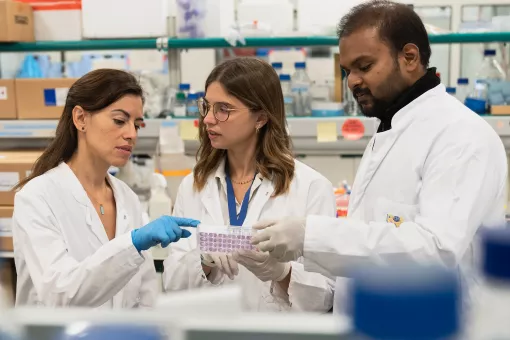

IRB Barcelona is a vibrant multidisciplinary institute where scientists address challenging and pressing biomedical problems in a collaborative fashion to provide groundbreaking solutions to unmet medical needs.
The IRB-DRIVE doctoral programme, an MSCA-COFUND initiative that succeeds IRB-TARGET, is designed to implement a fellow-centric, impact-oriented training itinerary. Through two separate calls, IRB-DRIVE will offer 10 four-year fellowships to outstanding doctoral candidates who will obtain their degree from the University of Barcelona (UB) or University Pompeu Fabra (UPF).
IRB-DRIVE is aimed at talented young researchers wishing to undertake their PhD theses in one of the 28 Institute's cutting-edge research groups participating in this call. These groups include ERC grant awardees and tackle frontier topics in personalized medicine, advanced therapies, cancer/metastasis, ageing, and AI-driven tools for healthcare, among others.
This innovative training programme provides a comprehensive itinerary, piloting a novel career-driven specialized track approach to prepare fellows for rewarding academic and extra-academic careers in biomedicine. Furthermore, IRB-DRIVE offers holistic support mechanisms that include a tailor-made mentoring agenda, extensive onboarding, and dedicated mental health support, facilitating the attraction, training, and career-readiness of highly qualified research professionals.
IRB-DRIVE offers:
- A highly competitive, four-year employment contract (PhD fellowship), aligned with the EU Charter & Code principles.
- Attractive salary and allowances, including a family allowance and a relocation budget.
- A generous dedicated annual budget for research costs, travel, networking, and university fees.
- Pioneering Career-driven Specialised Training Tracks developed with non-academic partners (e.g., SOLTI, Nuage, BIST) to broaden professional readiness and skills.
- Holistic Support Structure featuring a Tailor-made Mentoring Agenda, extensive onboarding, and dedicated Mental Health Support.
- Personalised Career Development Plan (PCDP) integrating complementary training and expert guidance for career progression.
- Specialized Training in Impact and Feedback to Policy, enhancing scientific communication skills and promoting influence in science policy decisions.
- Active Innovation Support from IRB's Innovation Department, including assistance with Intellectual Property (IP) identification and technology transfer.
- Compulsory secondments with international academic, clinical, or industrial associated partners to ensure intersectoral and international mobility.
- Flexible working conditions (e.g., possibility of fellowship extension in case of pregnancy or long-term leave).
- Access to state-of-the-art Core Facilities and scientific services at the Barcelona Science Park.

Co-funded by the European Union. Views and opinions expressed are however those of author(s) only and do not necessarily reflect those of the European Union or the European Research Executive Agency. Neither the European Union nor the European Research Executive Agency can be held responsible for them.
Eligibility
IRB-DRIVE will recruit prospective early-stage researchers (ESRs) of any nationality, gender, culture, religion, sexual orientation or age to undertake a PhD in biomedicine. To be eligible for an IRB-DRIVE fellowship, applicants must:
- Comply with the mobility rule: meaning that they must not have resided or carried out their main activity (work, studies, etc.) in Spain for more than 12 months in the 3 years immediately prior to the call
- Not be in possession of a doctoral degree at the deadline of the call. Any candidate that has successfully defended their doctoral thesis will not be considered eligible, even if they have not formally been awarded a doctoral degree.
- Fulfil one of the following options (mandatory requirements according to Bologna’s process to be able to enrol in a doctoral programme at the time of the effective recruitment):
- Completion of studies that lead to an official Spanish (or from another country of the European Higher Education Area) university degree awarding 300 ECTS credits, of which at least 60 must correspond to master level.
- Completion of a degree in a non-Spanish university not adapted to the European Higher Education Area that gives access to doctoral studies in Biology, Chemistry, Biochemistry, Pharmacy, Physics, Medicine or related fields in Spain.
- Submit a complete application before the established deadline through the IRB-DRIVE electronic application. Applicants will be asked to upload the following information:
- Personal information such as first and last name, gender, nationality and contact details. This section will also ask about applications for or intention to apply for other fellowships.
- Curriculum vitae.
- Motivation letter (maximum 2 pages) highlighting their research experience and academic achievements and explaining why they are interested in IRB Barcelona and in a particular research group.
- A scanned copy of their certified academic record. These documents must show the grades attained in exam periods and evidence that the required degree will be obtained by the expected time of recruitment if it has not already been awarded.
- Any additional files considered relevant to the application.
- At least two recommendation letters from university lecturers or scientists who are familiar with their academic work and who can judge their potential as a predoctoral researcher. A template letter for the referees will be provided, including short evaluation questions. Applicants will be responsible for ensuring that referees submit these letters.
- A summary of any work experience and a maximum of three research groups in which they are interested.
Candidates are selected exclusively on merit, on the basis of their curricula. The academic grades and curriculum vitae of each applicant are evaluated, as well as recommendation letters and a motivation letter. No selection criteria for positive or negative discrimination are applied.
Doctoral training programme
The IRB-DRIVE Doctoral Training Programme is engineered as a future-forward, fellow-centric itinerary designed not only to produce excellent scientific researchers but also highly qualified, versatile professionals ready for diverse career paths.
Our programme moves beyond traditional academic training by providing a truly comprehensive and structured four-year journey, ensuring every fellow finishes their PhD with maximum research impact and enhanced career readiness.
A Four-Pillar Training Structure
The IRB-DRIVE training model is structured around four essential and interlinked pillars, ensuring a holistic development experience:
- Research Excellence and Core Skills: Fellows integrate into one of the Institute's cutting-edge research groups, with access to state-of-the-art infrastructure and Core Facilities. This pillar is complemented by mandatory training modules in Scientific Integrity, Open Science, and Responsible Research and Innovation (RRI), ensuring research is conducted to the highest ethical and methodological standards.
- Personalised Career Development Plan (PCDP): Every fellow benefits from an individualised PCDP which is actively monitored and revisited throughout the programme. This unique plan goes beyond standard thesis monitoring, integrating specific soft skills training, guidance for impact generation, and expert advice to tailor the fellowship toward individual long-term goals.
- Intersectoral & International Mobility: IRB-DRIVE places high value on mobility and real-world experience. Fellows undertake compulsory secondments (short stays) with international academic, clinical, or non-academic associated partners. This ensures intersectoral and international mobility, broadening the fellow's network and professional perspective, which is crucial for future career success.
- Innovation and Specialisation Tracks: This pillar is the most distinct feature of IRB-DRIVE. We pilot Career-driven Specialised Training Tracks, designed in partnership with our non-academic network (including industry and business partners). These tracks provide specific training and exposure in fields outside core research (e.g., entrepreneurship, clinical trials, or policy making), preparing fellows for varied careers. Furthermore, the program provides Active Innovation Support from IRB's Innovation Department, including specialized training in Intellectual Property (IP) identification and technology transfer.
Holistic Support
We ensure a supportive and healthy environment through a comprehensive support package:
- A Tailor-made Mentoring Agenda that pairs fellows with senior researchers for personalised guidance.
- Extensive Onboarding to facilitate a smooth transition into both the Institute and life in Barcelona.
- Dedicated Mental Health Support to ensure the well-being and success of every fellow.
Partner institutions
I. Academic and Research Institutions
- Universitat de Barcelona (UB)
- Università degli Studi di Torino (UNITO)
- University of Copenhagen (UCPH)
- Barcelona Institute of Science and Technology (BIST)
II. Clinical and Biomedical Research Centres
- Vall d'Hebron Institute of Oncology (VHIO)
- Institut d'Investigacions Biomèdiques August Pi i Sunyer (IDIBAPS)
- Sant Joan de Déu Research Institute (FSJD)
- SOLTI
III. Industry, Consulting and Non-Academic Sector
Horizon Europe Marie Sklodowska-Curie Actions
The Marie Skłodowska-Curie actions (MSCA) provide grants for all stages of researchers' careers—be they doctoral candidates or highly experienced researchers—and encourage transnational, intersectoral and interdisciplinary mobility. The MSCA enable research-focused organisations (universities, research centres, and companies) to host talented foreign researchers and to create strategic partnerships with leading institutions worldwide.
The MSCA aim to equip researchers with the necessary skills and international experience for a successful career, either in the public or private sector. The programme responds to the challenges faced by researchers, offering them attractive working conditions and the opportunity to move between academia and other settings.
The MSCA are open to all domains of research and innovation, from fundamental research to market take-up and innovation services. Research and innovation fields are chosen freely by the applicants (individuals and/or organisations) in a fully 'bottom-up' manner.
For more information, please visit the following web pages:
Contacte






IRB Drive Opportunities
IRB Barcelona International PhD programme