
IRB Barcelona is a vibrant multidisciplinary institute where scientists address challenging and pressing biomedical problems in a collaborative fashion to provide groundbreaking solutions to unmet medical needs.
The IRB-TARGET doctoral programme brings together a network of 21 institutions to implement an impact-oriented training itinerary aligned with IRB’s strategic objective to bring fundamental science closer to applied and clinical research. Through two separate calls (2023 and 2024), IRB-TARGET will offer 10 four-year fellowships to exceptional doctoral candidates, who can choose and build a strong research project within one of the six interdisciplinary research nodes established at IRB.
IRB-TARGET is aimed at talented young researchers wishing to undertake their PhD theses in one of its 28 state-of-the-art laboratories that tackle cutting-edge topics in cancer/metastasis, ageing and cell reprogramming, metabolism, cell differentiation, and genomics, among others. In the context of inter- and multi-disciplinary collaboration between groups, countries (more than 100 international collaborations) and sectors (academy, industry or hospitals), IRB-TARGET offers customized training and ample career development opportunities. This innovative training programme stands out for fostering much valued secondments and other initiatives aimed at strengthening the career prospects of doctoral candidates.
IRB-TARGET offers:
- Exceptional working and employment conditions, with salaries that are significantly above the national standards.
- Excellent supervision and mentoring arrangements by highly experienced Group Leaders and external researchers from both the academic and the non-academic sectors.
- Access to top-notch laboratories carrying out Multidisciplinary Research at the interface between chemistry, biology and medicine.
- Exposure to an international and intersectoral environment and access to a vast network of international collaborators, companies and hospitals.
- Personalised doctoral training itinerary composed of several mandatory and optional components, categorised under research, training, and engagement, that fellows will complete to complement their research work (required dedication of 200 hours).
- Mandatory research stay or secondment as part of the doctoral training itinerary (research laboratory, industry or hospital).
- Integration of the Personalised Career Development Plan into the supervision structure and the harmonization of the research and career development objectives through a holistic training approach that incorporates specialised support from HFP.
- Free language courses (Catalan, Spanish & English) provided onsite and free of charge.
- Vibrant social activities, such as monthly "Cool-off sessions", where members meet informally for drinks, snacks and scientific discussions in the cafeteria, the Football League and the annual skiing trip.
- A healthy culture that promotes and facilitates well-being as an integral part of the institution’s identity.
- Relocation & Visa Assistance by trained staff in the Human Resources Department, and personalized welcome support with peer-to-peer mentoring.
More information about the IRB Barcelona International PhD programme, with details about the PhD life at the institute and other relevant activities and information can be found here.

Co-funded by the European Union. Views and opinions expressed are however those of author(s) only and do not necessarily reflect those of the European Union or the European Research Executive Agency. Neither the European Union nor the European Research Executive Agency can be held responsible for them.
Eligibility
IRB-TARGET will recruit prospective early-stage researchers (ESRs) of any nationality, gender, culture, religion, sexual orientation or age to undertake a PhD in biomedicine. To be eligible for an IRB_TARGET fellowship, applicants must:
- Comply with the mobility rule: meaning that they must not have resided or carried out their main activity (work, studies, etc.) in Spain for more than 12 months in the 3 years immediately prior to the call
- Not be in possession of a doctoral degree at the deadline of the call. Any candidate that has successfully defended their doctoral thesis will not be considered eligible, even if they have not formally been awarded a doctoral degree.
- Fulfil one of the following options (mandatory requirements according to Bologna’s process to be able to enrol in a doctoral programme at the time of the effective recruitment):
- Completion of studies that lead to an official Spanish (or from another country of the European Higher Education Area) university degree awarding 300 ECTS credits, of which at least 60 must correspond to master level.
- Completion of a degree in a non-Spanish university not adapted to the European Higher Education Area that gives access to doctoral studies in Biology, Chemistry, Biochemistry, Pharmacy, Physics, Medicine or related fields in Spain.
- Submit a complete application before the established deadline through the IRB-TARGET electronic application. Applicants will be asked to upload the following information:
- Personal information such as first and last name, gender, nationality and contact details. This section will also ask about applications for or intention to apply for other fellowships.
- Curriculum vitae.
- Motivation letter (maximum 2 pages) highlighting their research experience and academic achievements and explaining why they are interested in IRB Barcelona and in a particular research group.
- A scanned copy of their certified academic record. These documents must show the grades attained in exam periods and evidence that the required degree will be obtained by the expected time of recruitment if it has not already been awarded.
- Any additional files considered relevant to the application.
- At least two recommendation letters from university lecturers or scientists who are familiar with their academic work and who can judge their potential as a predoctoral researcher. A template letter for the referees will be provided, including short evaluation questions. Applicants will be responsible for ensuring that referees submit these letters.
- A summary of any work experience and a maximum of three research groups in which they are interested.
Candidates are selected exclusively on merit, on the basis of their curricula. The academic grades and curriculum vitae of each applicant are evaluated, as well as recommendation letters and a motivation letter. No selection criteria for positive or negative discrimination are applied.
Doctoral training programme
Each IRB-TARGET fellow will build their own unique doctoral training itinerary that is adapted to their research, academic, professional and personal requirements and will prepare them to excel during and after their doctoral training. The personalized IRB-TARGET itinerary will be composed of several mandatory and options components that fellows will complete to complement their research work categorized under research, training and engagement. The itinerary will be defined in collaboration with the supervisory team and will be reflected in their Personal Career Development Plan (PCDP). Fellows will need to complete a minimum required dedication (200 hours) to each category and subcategory to successfully complete the IRB-TARGET programme.
The major components of this itinerary include ( see table below):
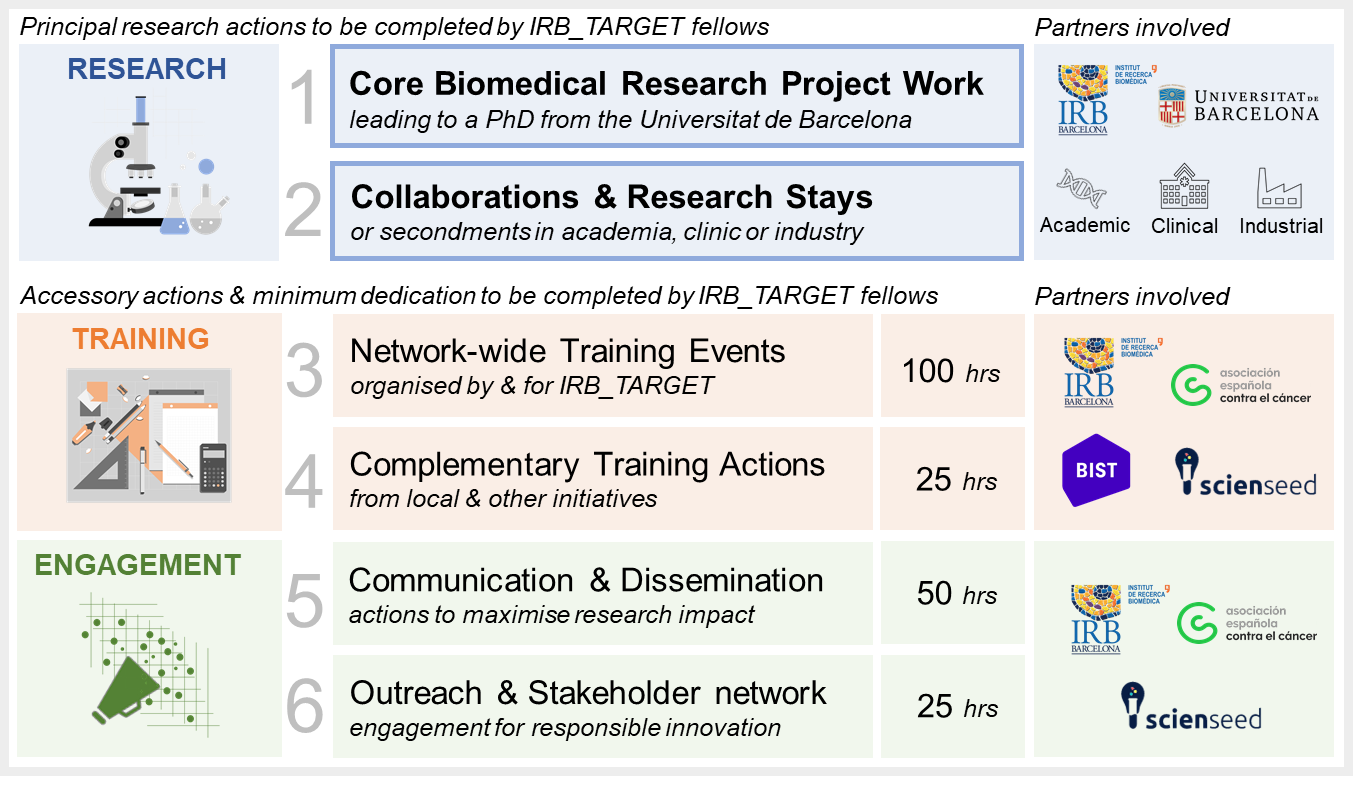
- Core biomedical research project: Fellows will undertake a research project in a given field under the supervision of a Group Leader leading to a doctoral degree at the University of Barcelona. They will further enrich this research training through weekly participation in group (lab) meetings, interdisciplinary node and plenary seminars, PhD retreats, and symposiums.
- Collaborations & research stays or secondments in academia, clinical setting, or industry (1-3 months): Either through a secondment or a short stay, IRB-TARGET fellows will be required to complete a mandatory research stay or secondment as part of their doctoral training itinerary, unless explicitly discouraged by their Thesis Advisory Committee (TAC).
- Network-wide training events organised by and for IRB-TARGET (100 hours): These mandatory training events will provide fellows with knowledge, skills and expertise in several core areas that are integral to their doctoral training, including research integrity, gender in research, entrepreneurship skills, open science and research data management, and communication.
- Complementary training actions from local and other initiatives (25 hours): Fellows will have the opportunity to choose the training sessions and topics that best suit their needs and interests.
- Communication and Dissemination actions to maximise research impact (50 hours): Having done a mandatory training course on communication given by Scienseed and had opportunities to fine-tune these skills at the institutional level by participation and presentation at group meetings, node seminars and plenary seminars, fellows will be required to further their communication and dissemination skills.
- Outreach and Stakeholder network engagement for responsible innovation (25 hours): (a) With the support and guidance of IRB Barcelona´s Communication Department and the Public Engagement Officer in particular, IRB-TARGET fellows will contribute to outreach actions to disseminate science to the general public. (b) To engage with the stakeholders and/or end-users of biomedical researchers, IRB-TARGET fellows will organise, conduct and amplify the impact of an online talk show to discuss important themes with respect to science, research and policy with guests representing key stakeholders.
Each fellow has the support of the following actors in the implementation and revision of their PCDP: the Group Leader and the co-supervisor(s), including in the secondment lab(s); the Thesis Advisory Committee (TAC); and the Career support team.
IRB-TARGET fellows will be awarded their doctoral degrees from the University of Barcelona. More information on the available doctoral programmes within this university can be found here.
Partner institutions
Fundació de Recerca Clínic Barcelona-Institut d’Investigacions Biomèdiques August Pi i Sunyer
Fundació Privada per a la Recerca i la Docència Sant Joan de Déu (FSJD-CERCA)
Fundació Privada Institut d’Investigació Oncològica de Vall d’Hebron (VHIO)
Radboud University Medical Centre (Radboudumc)
Josep Carreras Leukaemia Research Institute
European Molecular Biology Laboratory
University of Groningen, Groningen Research Institute of Pharmacy (GRIP)
School of Biomedical Science, McGill University
National University of Ireland Galway
Università degli Studi di Torino, Molecular Biotechnology Center (MCB)
Horizon Europe Marie Sklodowska-Curie Actions
The Marie Skłodowska-Curie actions (MSCA) provide grants for all stages of researchers' careers—be they doctoral candidates or highly experienced researchers—and encourage transnational, intersectoral and interdisciplinary mobility. The MSCA enable research-focused organisations (universities, research centres, and companies) to host talented foreign researchers and to create strategic partnerships with leading institutions worldwide.
The MSCA aim to equip researchers with the necessary skills and international experience for a successful career, either in the public or private sector. The programme responds to the challenges faced by researchers, offering them attractive working conditions and the opportunity to move between academia and other settings.
The MSCA are open to all domains of research and innovation, from fundamental research to market take-up and innovation services. Research and innovation fields are chosen freely by the applicants (individuals and/or organisations) in a fully 'bottom-up' manner.
For more information, please visit the following web pages:
Contact






IRB Target Opportunities
IRB Barcelona International PhD programme: on TARGET for high-impact biomedicine