

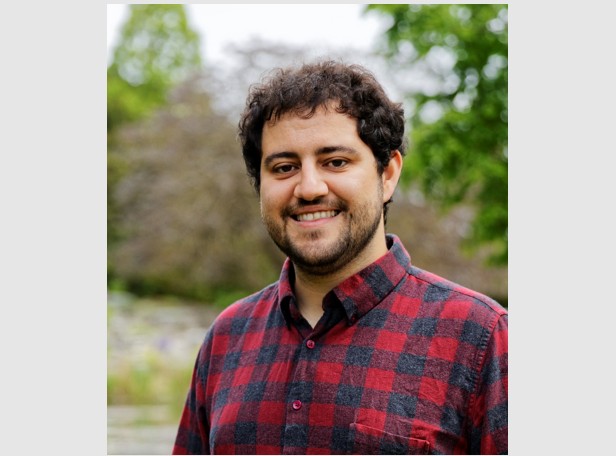
Speaker: Dr. Jan Huertas Martín
Postdoctoral Researcher, Computational Modelling of Multiscale Biomolecular Organisation (Collepardo Lab), Cambridge University (UK)
Presentation
Host: Dr. Modesto Orozco, Group Leader - Molecular Modelling and Bioinformatics - IRB Barcelona
Node: Computational Biology / Cell Pathophysiology
Date: Wednesday 23 September 2026, 12:00h
Place: Auditorium Room - PCB
In eukaryotic cells, DNA is packaged into chromatin, a highly compact and dynamic structure whose organisation regulates gene expression by modulating DNA accessibility. Chromatin architecture is a multiscale problem: Local nucleosome conformations and interaction networks give rise to higher-order fibre organisation and mesoscale domains with distinct material properties. Understanding how these emergent chromatin states arise from underlying molecular interactions remains a central challenge to understand genome regulation.
In this talk, I will present two recent efforts that use multiscale simulations to dissect the physical principles underlying chromatin organisation. In the first study, we focus on understanding chromatin condensates, by integrating cryo-electron tomography (cryo-ET) with our coarse-grained chromatin models. These simulations resolve chromatin fibers inside droplets at single amino-acid and base-pair resolution and reveal how linker DNA length controls nucleosome geometry, interaction networks, and material properties through distinct histone tail–mediated contacts.
In the second story, we dig deeper into how the structures of chromatin fibers are modulated by other proteins. I will describe how the pioneer transcription factor Oct4 can reshape chromatin fibres beyond the scale of a single nucleosome. Using coarse-grained molecular dynamics simulations of full-length Oct4 interacting with nucleosome fibres of varying nucleosomal repeat lengths, we show that Oct4 enhances DNA accessibility not by global decondensation, but by driving chromatin into compact, liquid-like states in which nucleosomes breathe, reorient, exchange neighbours, and transiently expose DNA.
Together, these studies establish how chromatin architecture, dynamics, and accessibility emerge from multivalent molecular interactions, and illustrate how multiscale simulations can provide mechanistic insight into chromatin regulation at submolecular resolution.
IMPORTANT: For attendees outside the PCB community you must register at least 24h before the seminar.
The weekly seminars at IRB Barcelona are scientific events primarily addressed to the Institute’s research community and professionals in the biomedical field. Attendance is intended exclusively for individuals with a genuine and justified scientific interest in the seminar content. Registration should not be used to request supporting documents for visa or immigration purposes. For participants residing outside Spain, in-person attendance requires a formal invitation issued by an IRB Barcelona research group or department. Without such an invitation, access to the institute cannot be guaranteed. IRB Barcelona reserves the right to review and verify all seminar registrations.