Images
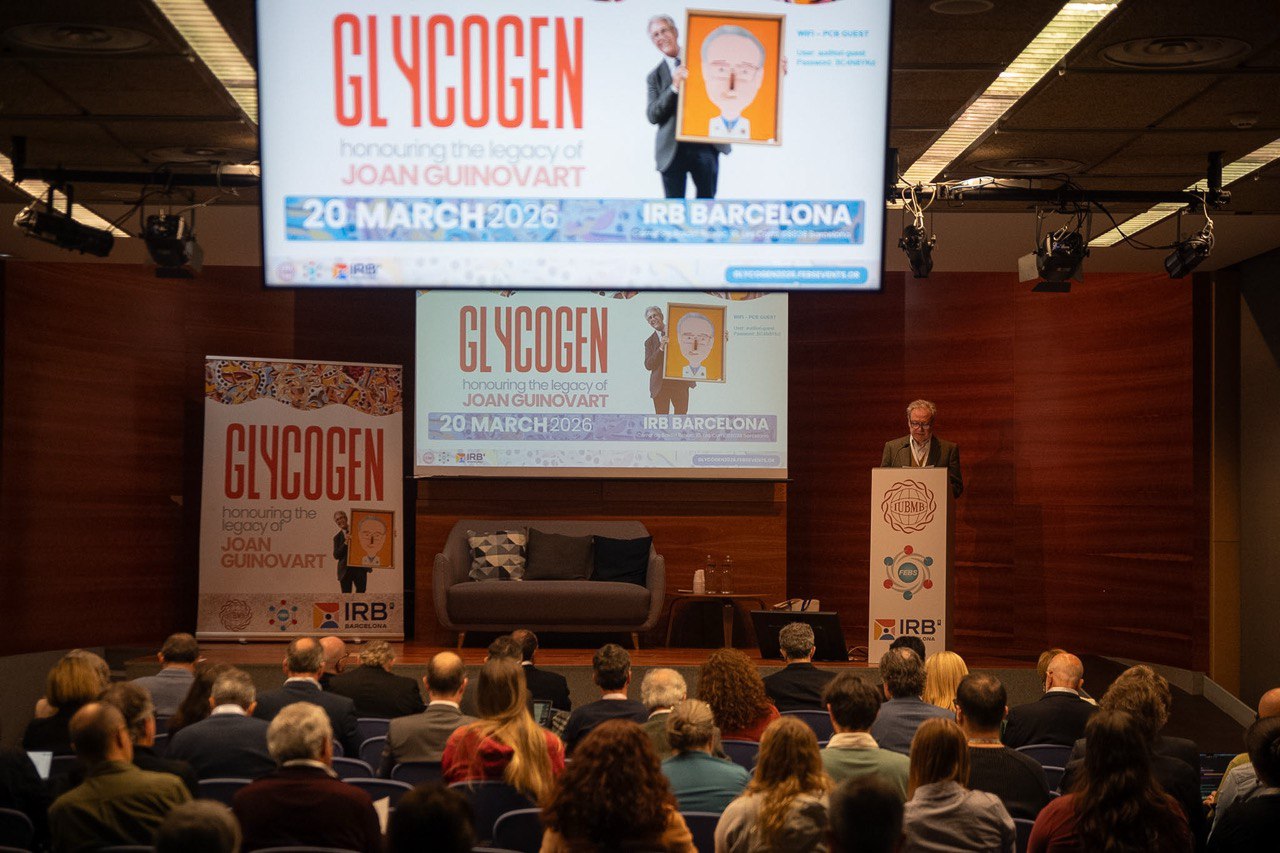
- The Glycogen Symposium – Honouring the Legacy of Joan Guinovart held last week brought together leading international experts to explore the latest advances in glycogen biology, from molecular mechanisms to its role in metabolism, the brain, and disease.
- The event was organised jointly by IRB Barcelona, FEBS and the IUBMB.
- The meeting paid tribute to Dr. Joan Guinovart’s scientific legacy, highlighting his lasting impact on glycogen research and his key role in founding IRB Barcelona.
The Glycogen Symposium – Honouring the Legacy of Joan Guinovart, held last Friday, March 20, at IRB Barcelona, organised jointly by IRB Barcelona, FEBS and the IUBMB, brought together leading international researchers in Barcelona for a day of scientific exchange dedicated to celebrating scientific legacy of Dr. Joan Guinovart (1947–2025).
Recognised as one of the world’s foremost experts in glycogen metabolism, Dr. Joan Guinovart made lasting contributions to our understanding of how glycogen is synthesised, regulated, and used across tissues, and how its dysfunction is linked to disease. He also played a key role in founding IRB Barcelona, the institute that hosted the event.
In tribute to his legacy, the symposium gathered scientists whose work reflects and expands on the research areas Dr. Guinovart helped shape. Across three sessions, the programme explored the many facets of glycogen biology, from its molecular regulation to its role in the brain, muscle, metabolism, and disease.
The morning session, chaired by Dr. Alexandra Newton (UC San Diego), focused on fundamental mechanisms and neurological aspects. Dr. Philip Cohen (University of Dundee) opened the event by highlighting the connection between glycogen and ubiquitin pathways, offering a broad perspective on cellular regulation. Dr. Jordi Duran (IRB Barcelona alumnus and now at IQS) then examined the specific roles of glycogen in different brain cell types, while Pascual Sanz (IBV-CSIC) addressed how glycogen dysfunction contributes to Lafora disease. The session closed with an intervention by Dr. Kit Donohue (Chelsea's Hope Lafora Children Research Fund), who reflected on Guinovart’s dedication to advancing research in this rare condition.
The midday session, chaired by Dr. Ana Victoria Lechuga-Vieco (IRB Barcelona), shifted the focus to metabolism and exercise. Dr. Alan Saltiel (UC San Diego) discussed how glycogen supports adaptation to metabolic stress, and Lykke Sylow (University of Copenhagen) explored its role during physical activity. Dr. Marcelo Guerin (IBMB-CSIC) introduced an evolutionary angle through bacterial glycogen metabolism, while Dr. Kei Sakamoto (University of Copenhagen) reviewed how glycogen synthesis and use are regulated in skeletal muscle, drawing on insights shaped by Dr. Guinovart’s work.
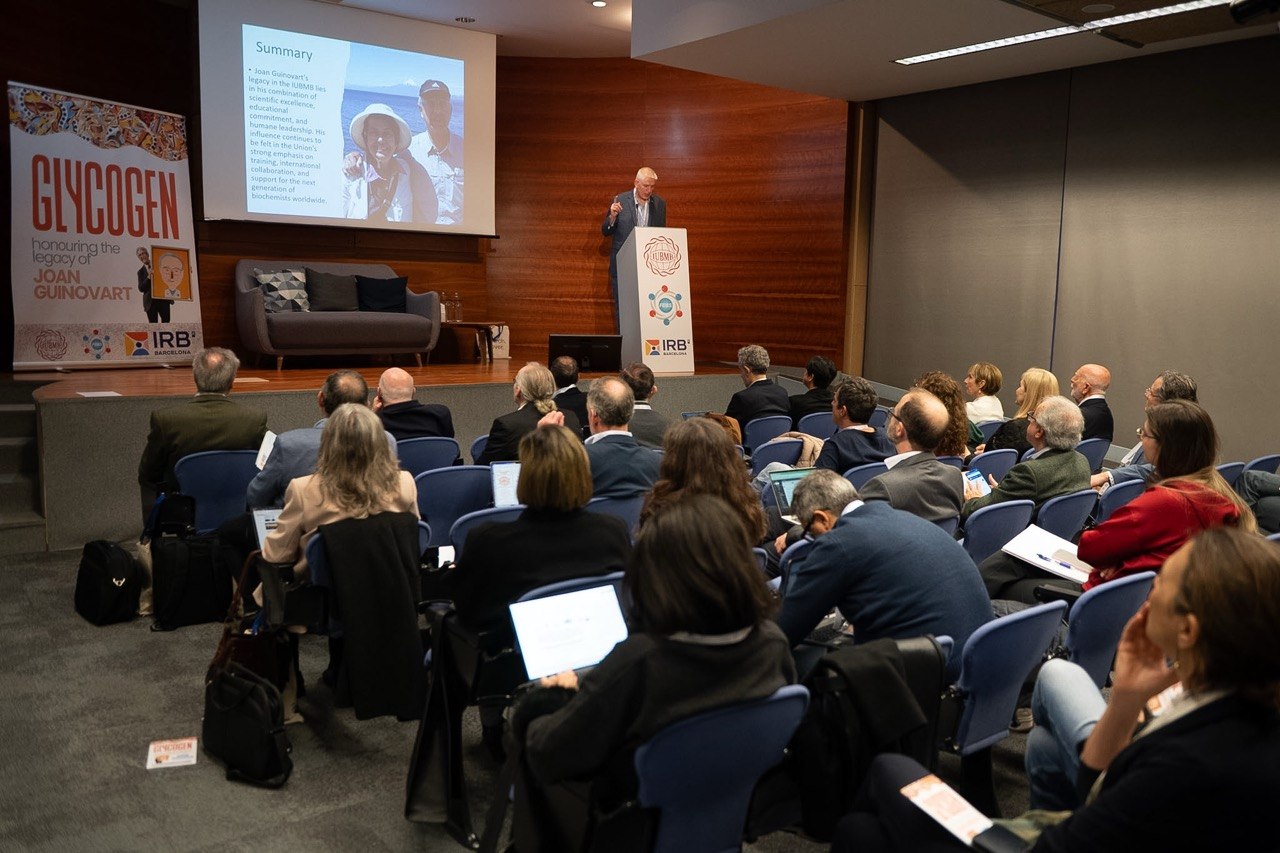
In the afternoon session, chaired by Dr. Jerka Dumic (University of Zagreb & FEBS), speakers explored emerging links between glycogen and broader cellular processes. Dr. David Komander (WEHI) presented new findings on glycogen ubiquitination, and Dr. Matthew Gentry (University of Florida) discussed how altered glycogen metabolism impacts neurological disorders and cancer. Dr. Marc Claret (IDIBAPS) focused on glycogen’s role in neuronal activation, while Dr. Elton Zeqiraj (University of Leeds) shared structural insights into glycogen synthase regulation. Dr. Anna DePaoli-Roach (Indiana University) concluded the talks with a personal reflection on Guinovart’s early scientific career.
The symposium ended with an open discussion, followed by closing remarks from Dr. Francesc Posas, Director of IRB Barcelona, and a commemorative video honouring Dr. Joan Guinovart’s scientific and personal legacy.
Bringing together leading voices in the field, the event paid tribute to a pioneering scientist and also highlighted the continued relevance and impact of his work, fostering dialogue and collaboration across the glycogen research community.
About IRB Barcelona
The Institute for Research in Biomedicine (IRB Barcelona) pursues a society free of disease. To this end, it conducts multidisciplinary research of excellence to cure cancer and other diseases linked to ageing. It establishes technology transfer agreements with the pharmaceutical industry and major hospitals to bring research results closer to society, and organises a range of science outreach activities to engage the public in an open dialogue. IRB Barcelona is an international centre that hosts 400 researchers and more than 30 nationalities. Recognised as a Severo Ochoa Centre of Excellence since 2011, IRB Barcelona is a CERCA centre and member of the Barcelona Institute of Science and Technology (BIST).