Images

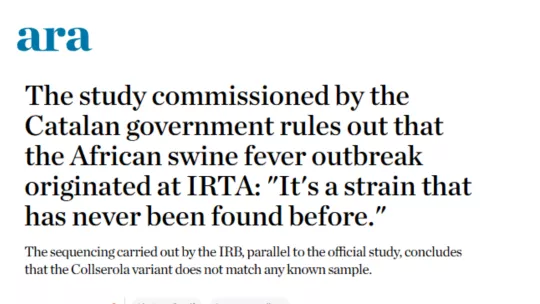
• The comparative genomic analysis, led by Dr. Toni Gabaldón, finds no matches between the virus detected in wild boars and the variants studied at IRTA-CReSA.
• The sequence shows genetic changes that point to a variant not previously described in the databases consulted.
At the end of November, an outbreak of African swine fever (ASF) was detected in Catalonia. It is a viral disease that does not affect humans, but can have a significant impact on the pig sector, and therefore requires surveillance and control measures.
In this context, at the request of the Government of Catalonia, IRB Barcelona carried out a comparative genomic analysis led by Dr. Toni Gabaldón to characterize the detected virus and assess its relationship with variants analyzed at IRTA-CReSA. Preliminary results, made public on 30 December, show that the genome of the virus identified in wild boars does not match the variants studied at IRTA-CReSA, allowing this hypothesis to be ruled out on the basis of the available genetic evidence.
In addition, the analysis indicates that the outbreak sequence shows distinct genetic features (including changes not observed in the variants compared) and points to a variant not previously described among the sequences consulted in public databases or in genomes associated with other outbreaks.
“The genomic comparison does not show a relationship with the variants studied at IRTA-CReSA, nor with public databases. Based on the differences observed, this points to a variant not described to date. Further investigations and expanded comparative analyses will be carried out to better determine its possible origin,” says Dr. Toni Gabaldón, ICREA researcher and head of the Comparative Genomics lab at IRB Barcelona and the Barcelona Supercomputing Center (BSC).
Sequencing and genomic analysis are essential tools for outbreak monitoring, as they provide objective information on the relationships between variants and complement epidemiological investigations. Conclusions regarding the origin and dynamics of the outbreak will be drawn by the competent authorities and reference laboratories, based on the full body of available evidence.
About IRB Barcelona
The Institute for Research in Biomedicine (IRB Barcelona) pursues a society free of disease. To this end, it conducts multidisciplinary research of excellence to cure cancer and other diseases linked to ageing. It establishes technology transfer agreements with the pharmaceutical industry and major hospitals to bring research results closer to society, and organises a range of science outreach activities to engage the public in an open dialogue. IRB Barcelona is an international centre that hosts 400 researchers and more than 30 nationalities. Recognised as a Severo Ochoa Centre of Excellence since 2011, IRB Barcelona is a CERCA centre and member of the Barcelona Institute of Science and Technology (BIST).