Images
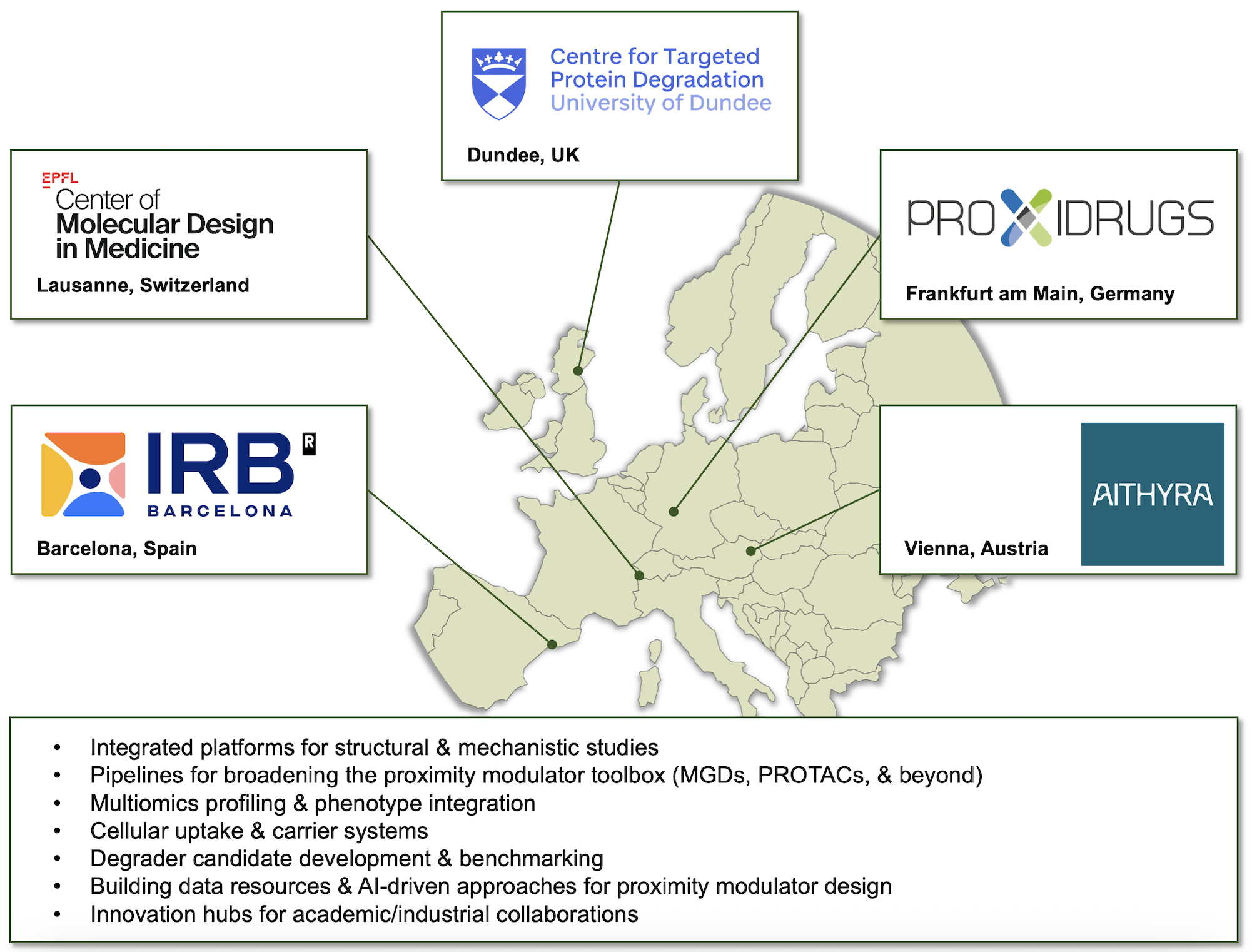
- The article, published in Molecular Cell, proposes the creation of a European Alliance to accelerate the development of proximity-induced therapies.
- These innovative therapies aim to harness molecular proximity to eliminate or modulate disease-related proteins that were previously considered undruggable.
In a newly published Perspective in Molecular Cell, scientists from six leading European research institutions, Goethe University Frankfurt, IRB Barcelona, CeMM and AITHYRA in Vienna, the University of Dundee, and EPFL Lausanne, propose the creation of a European Alliance to accelerate the development of proximity-induced drug modalities.
These therapeutic approaches, which include targeted protein degradation via PROTACs and molecular glue degraders, and emerging technologies including artificial intelligence (AI) and machine learning, seek to harness the power of induced proximity to eliminate or modulate disease-relevant proteins, many of which are currently considered undruggable.
Authors Ivan Dikic, Cristina Mayor-Ruiz, Georg Winter, Kerstin Koch, Alessio Ciulli, and Nicolas Thomä, emphasize the foundational role of academia in advancing this field and call for tighter academic-industry collaboration to unlock its full therapeutic potential.
“Harnessing proximity-induced pharmacology offers unprecedented opportunities to modulate disease-driving proteins once deemed undruggable, truly expanding the frontiers of therapeutic innovation. This Alliance is designed to catalyze collaboration between academia to speed scientific discoveries toward real patient impact", states Dr. Cristina Mayor-Ruiz, Group Leader of the Targeted Protein Degradation and Drug Discovery laboratory at IRB Barcelona.
The Perspective outlines recent scientific breakthroughs, including the evolution of PROTACs from concept to clinic, rational design of molecular glues, and novel strategies to redirect cellular degradation machinery. It also discusses how AI and machine learning have the potential to accelerate proximity-induced drug discovery.
The proposed Alliance aims to pool expertise, infrastructure, and digital platforms across Europe to train future leaders, boost translational research, invite other colleagues to join, and accelerate the development of next-generation proximity-based therapies.
Key points
- Revolutionary therapeutics: Proximity-inducing drugs such as PROTACs and molecular glue degraders can remove disease-causing proteins opening new possibilities for previously “undruggable” targets.
- A European powerhouse ready to unite: Leading academic hubs in Frankfurt, Barcelona, Dundee, Lausanne, and Vienna bring world-class expertise and aim for coordinated collaboration among academic institutions and with industry to fully realize their potential.
- A call to action: Authors urge the formation of a global academic–industry alliance to share resources, accelerate early-stage drug discovery, and train the next generation of scientists, ensuring faster translation of breakthroughs to the clinic.
Related article
Opportunities in proximity modulation: Bridging academia and industry
Ivan Dikic, Cristina Mayor-Ruiz, Georg E. Winter, Kerstin Koch, Alessio Ciulli, Nicolas H. Thomä.
Molecular Cell (2025). DOI: https://doi.org/10.1016/j.molcel.2025.07.018
About IRB Barcelona
The Institute for Research in Biomedicine (IRB Barcelona) pursues a society free of disease. To this end, it conducts multidisciplinary research of excellence to cure cancer and other diseases linked to ageing. It establishes technology transfer agreements with the pharmaceutical industry and major hospitals to bring research results closer to society, and organises a range of science outreach activities to engage the public in an open dialogue. IRB Barcelona is an international centre that hosts 400 researchers and more than 30 nationalities. Recognised as a Severo Ochoa Centre of Excellence since 2011, IRB Barcelona is a CERCA centre and member of the Barcelona Institute of Science and Technology (BIST).