Images
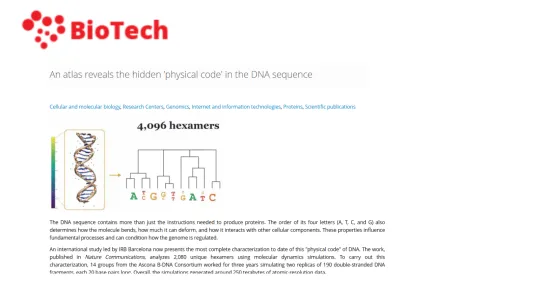
- An international consortium led by IRB Barcelona has produced the first comprehensive atlas showing how the DNA sequence determines its shape, flexibility, and movements at the hexamer level.
- These physical properties influence how DNA interacts with proteins and organizes itself inside the cell and are essential for understanding genome regulation.
- The analysis of 2,080 unique hexamers using long-duration molecular dynamics simulations provides evidence that this physical behaviour of DNA has influenced genome evolution.
The DNA sequence contains more than just the instructions needed to produce proteins. The order of its four letters (A, T, C, and G) also determines how the molecule bends, how much it can deform, and how it interacts with other cellular components. These properties influence fundamental processes and can condition how the genome is regulated.
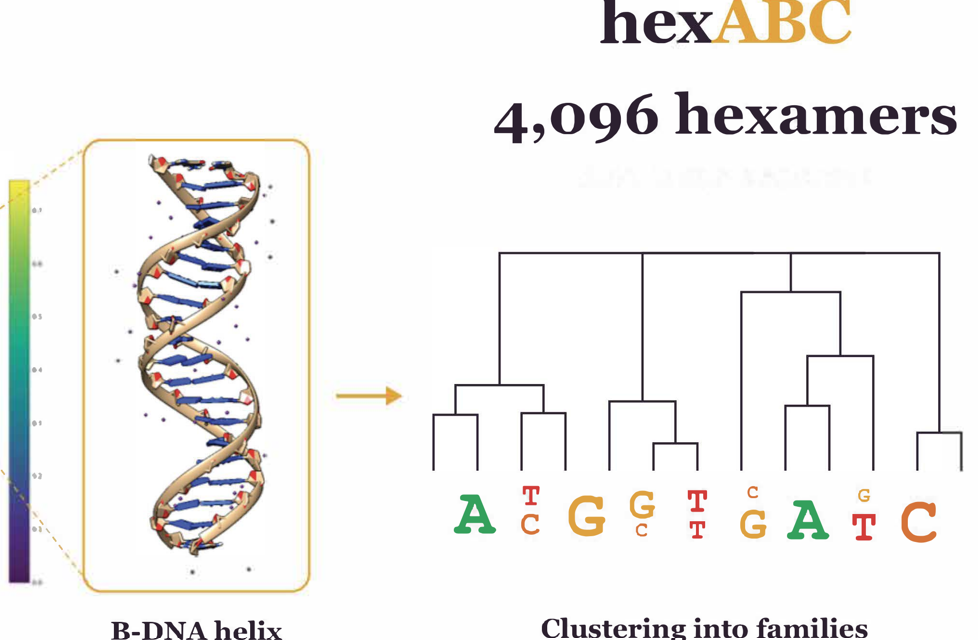
An international study led by IRB Barcelona now presents the most complete characterization to date of this "physical code" of DNA. The work, published in Nature Communications, analyzes 2,080 unique hexamers using molecular dynamics simulations. To carry out this characterization, 14 groups from the Ascona B-DNA Consortium worked for three years simulating two replicas of 190 double-stranded DNA fragments, each 20 base pairs long. Overall, the simulations generated around 250 terabytes of atomic-resolution data.
"To function, DNA must bend, open, and interact with numerous proteins. Therefore, knowing how the nature of the sequence conditions its physical behaviour is essential for understanding genome regulation and evolution, beyond the information contained in genes," explains Dr. Modesto Orozco, ICREA researcher, head of the Molecular Modeling and Bioinformatics Laboratory at IRB Barcelona, and professor at the University of Barcelona, who led the study.
A dynamic molecule
The atlas shows that DNA fragments with a similar composition can behave very differently depending on the order of their bases. The duration of the simulations also made it possible to observe rare phenomena, such as transient openings and partial unwindings of the double helix.
"We have been able to observe both the typical behaviour of each sequence and exceptional movements that normally fall outside the reach of simulations. The result is a reference map for understanding the physical diversity of DNA," notes Dr. Federica Battistini, first author of the work, lecturer at the University of Barcelona, and researcher at IRB Barcelona.
A footprint in genome evolution
The team sought to determine whether these physical properties had influenced genome evolution. To this end, they studied regions that do not contain instructions to produce proteins and observed that the most frequent sequences tend to better resist small changes: even if one of their letters is substituted, their shape and movements are barely altered.
Although the observed trend is moderate, the results suggest that evolution may have favoured sequences capable of preserving the physical properties necessary for DNA function.
The data generated have been made available to the scientific community following the FAIR principles. This resource can be used to develop simplified computational models and artificial intelligence systems capable of representing DNA and chromatin at larger scales.
The 14 groups of the Ascona B-DNA Consortium participated in the work, with involvement from institutions in Spain, France, the United Kingdom, the United States, Germany, Poland, Switzerland, Uruguay, and Lithuania. The study received funding from the foloowing: the European Commission, through BioExcel and the MDDB project; the Ministry of Science, Innovation and Universities; the Carlos III Health Institute; the European Regional Development Fund; and the Generalitat de Catalunya, through AGAUR. It also used computing resources from the Barcelona Supercomputing Center and other international infrastructures.
Reference article:
hexABC seeking the physical code of DNA
Federica Battistini, Miłosz Wieczór, Adam Hospital, Marco Pasi, Juan Pablo Arcón, Israel Serrano-Chacón, Alba Sala, Subhamoy Deb, Agustín García-Doñate, Matthew Burman, Elliot W. Chan, Liwei Chang, Gabriela da Rosa, Jorge R. Espinosa, Gia Linh Hoang, Kazi A. Hossain, Michał Jurkowski, Romain Poupon, Rahul Sharma, Ran Sun, Thomas C. Bishop, Paolo Carloni, Thomas E. Cheatham III, Rosana Collepardo-Guevara, Jacek Czub, Pablo D. Dans, Sarah A. Harris, Charles Laughton, Rodrigo Galindo-Murillo, John H. Maddocks, Agnes Noy, Alberto Pérez, Daiva Petkevičiūtė-Gerlach & Modesto Orozco
Nature Communications (2026) DOI: 10.1038/s41467-026-74390-5
About IRB Barcelona
The Institute for Research in Biomedicine (IRB Barcelona) pursues a society free of disease. To this end, it conducts multidisciplinary research of excellence to cure cancer and other diseases linked to ageing. It establishes technology transfer agreements with the pharmaceutical industry and major hospitals to bring research results closer to society, and organises a range of science outreach activities to engage the public in an open dialogue. IRB Barcelona is an international centre that hosts 400 researchers and more than 30 nationalities. Recognised as a Severo Ochoa Centre of Excellence since 2011, IRB Barcelona is a CERCA centre and member of the Barcelona Institute of Science and Technology (BIST).