Images
- Researchers at IRB Barcelona, in collaboration with MIT and Scripps Research, identify signals in transfer RNAs that provide insights into the origin of these molecules and the genetic code.
- The work, published in PNAS, analyzed more than 70,000 sequences and strengthens the hypothesis that present-day transfer RNAs evolved from simpler molecules.
The genetic code determines the correspondence between genetic instructions and amino acids—the building blocks that form proteins. How this correspondence arose is one of the major open questions in evolutionary biology. A study led by Dr. Lluís Ribas de Pouplana, ICREA researcher at IRB Barcelona, and Dr. Paul Schimmel, with the participation of researchers from MIT and Scripps Research, has identified conserved signals in transfer RNAs that could help reconstruct the early stages of this system.
The paper, published in the journal PNAS, features two undergraduate students as first authors who completed placements in IRB Barcelona's Gene Translation Laboratory, demonstrating the Institute’s commitment to training young talent.
Transfer RNAs, or tRNAs, act as a bridge between genetic instructions and amino acids during protein synthesis. In one region, they contain the anticodon, a group of three RNA "letters" that recognizes a genetic instruction. At another end, the corresponding amino acid attaches. These two points are physically far apart in the present-day molecule, raising the question of how the connection between them was established during evolution.
“In current tRNAs we have identified signals compatible with a simpler system that linked RNA sequences to amino acids. These results provide new insights into how the genetic code developed,” explains Dr. Ribas de Pouplana.
A prediction about the origin of tRNAs
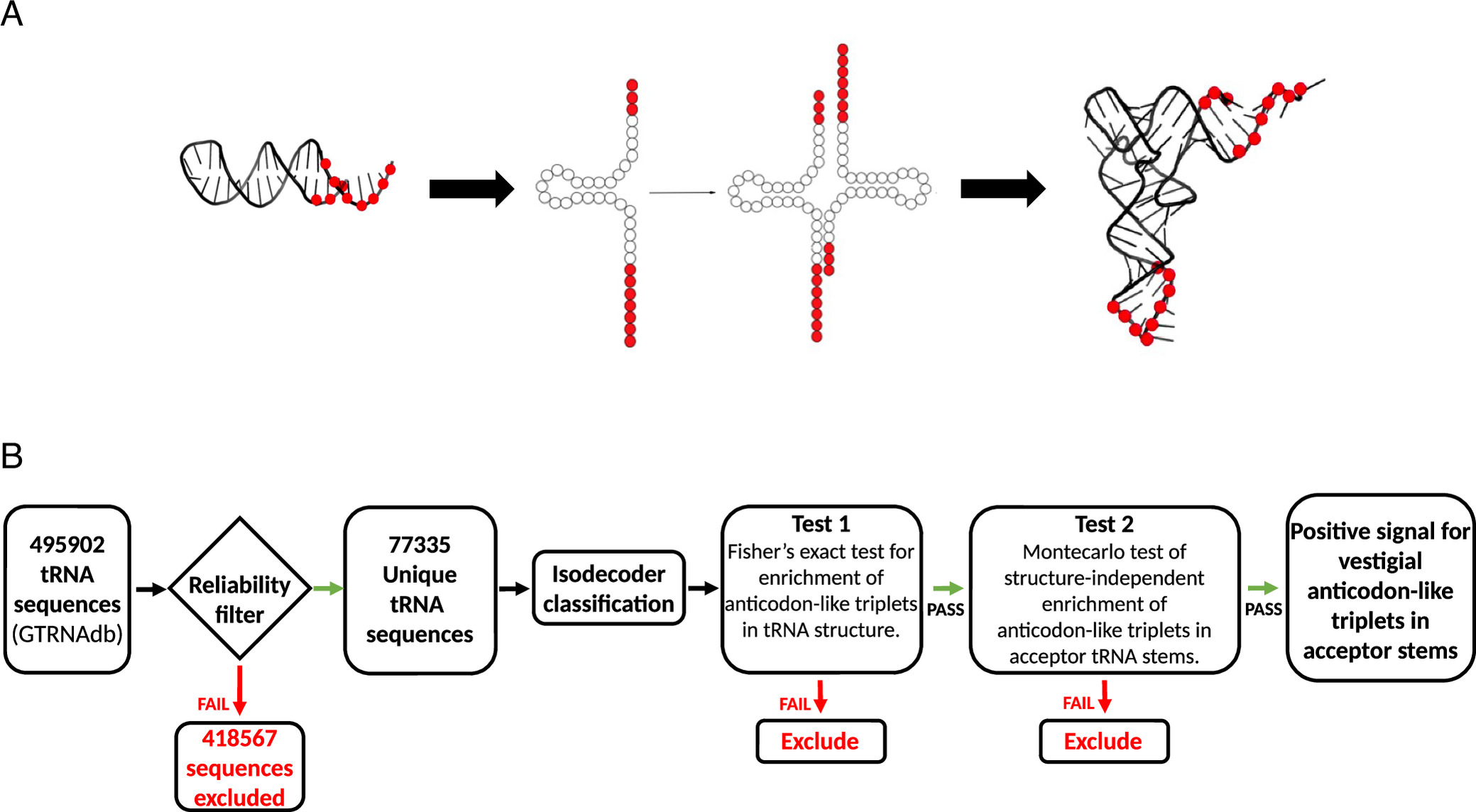
One of the main hypotheses proposes that tRNAs evolved from small RNA structures folded into a hairpin shape, called mini-helices. According to this notion, the three-letter groups that make up the anticodon today would have already been present in these primitive RNAs, near the amino acid attachment site. The model therefore predicts that present-day tRNAs could retain copies of these triplets in that same area, the acceptor stem.
To test this prediction, the team analyzed more than 70,000 tRNA gene sequences from nearly 5,000 genomes across bacteria, archaea, and eukaryotes. The dataset was obtained after filtering nearly half a million sequences and is the largest used to date in this type of analysis.
To check whether the signals could be explained solely by the structure of the RNA, the team compared the real sequences with simulated versions of equivalent structure. In several groups of tRNAs, the triplets appear more frequently than predicted by these simulations, which further supports the possibility that they are remnants of an ancestral system.
“The key was to verify that the signal persisted when taking into account the structural constraints of the molecule. This control supports the interpretation that the observed patterns may contain information about their evolutionary history,” notes Dr. Ribas de Pouplana.
Insights into the expansion of the genetic code
The team compared the intensity of these signals with the proposed chronology for the incorporation of amino acids into the genetic code. In general, the patterns are stronger in tRNAs associated with amino acids that, according to this timeline, were incorporated earlier into the code—such as glycine, alanine, or valine—and weaker in those associated with late incorporations, such as tyrosine and tryptophan. This agreement provides additional support for a progressive development of the genetic code.
The study also detected triplets in other arms of the tRNA, an observation that the mini-helix hypothesis does not explain on its own. The results offer insights into an ancestral system, but the exact pathway that led to present-day molecules remains an open question.
The work received funding from the Ministry of Science, Innovation and Universities, the State Research Agency, and ERDF from the European Union.
Related article:
Molecular fossils of an ancestral code revealed by large-scale analysis of tRNAs
A. Nova, P. Martín-Cabezas, S. Ovchinnikov, P. Schimmel & L. Ribas de Pouplana.
PNAS (2026) DOI: 10.1073/pnas.2627541123
About IRB Barcelona
The Institute for Research in Biomedicine (IRB Barcelona) pursues a society free of disease. To this end, it conducts multidisciplinary research of excellence to cure cancer and other diseases linked to ageing. It establishes technology transfer agreements with the pharmaceutical industry and major hospitals to bring research results closer to society, and organises a range of science outreach activities to engage the public in an open dialogue. IRB Barcelona is an international centre that hosts 400 researchers and more than 30 nationalities. Recognised as a Severo Ochoa Centre of Excellence since 2011, IRB Barcelona is a CERCA centre and member of the Barcelona Institute of Science and Technology (BIST).