Images
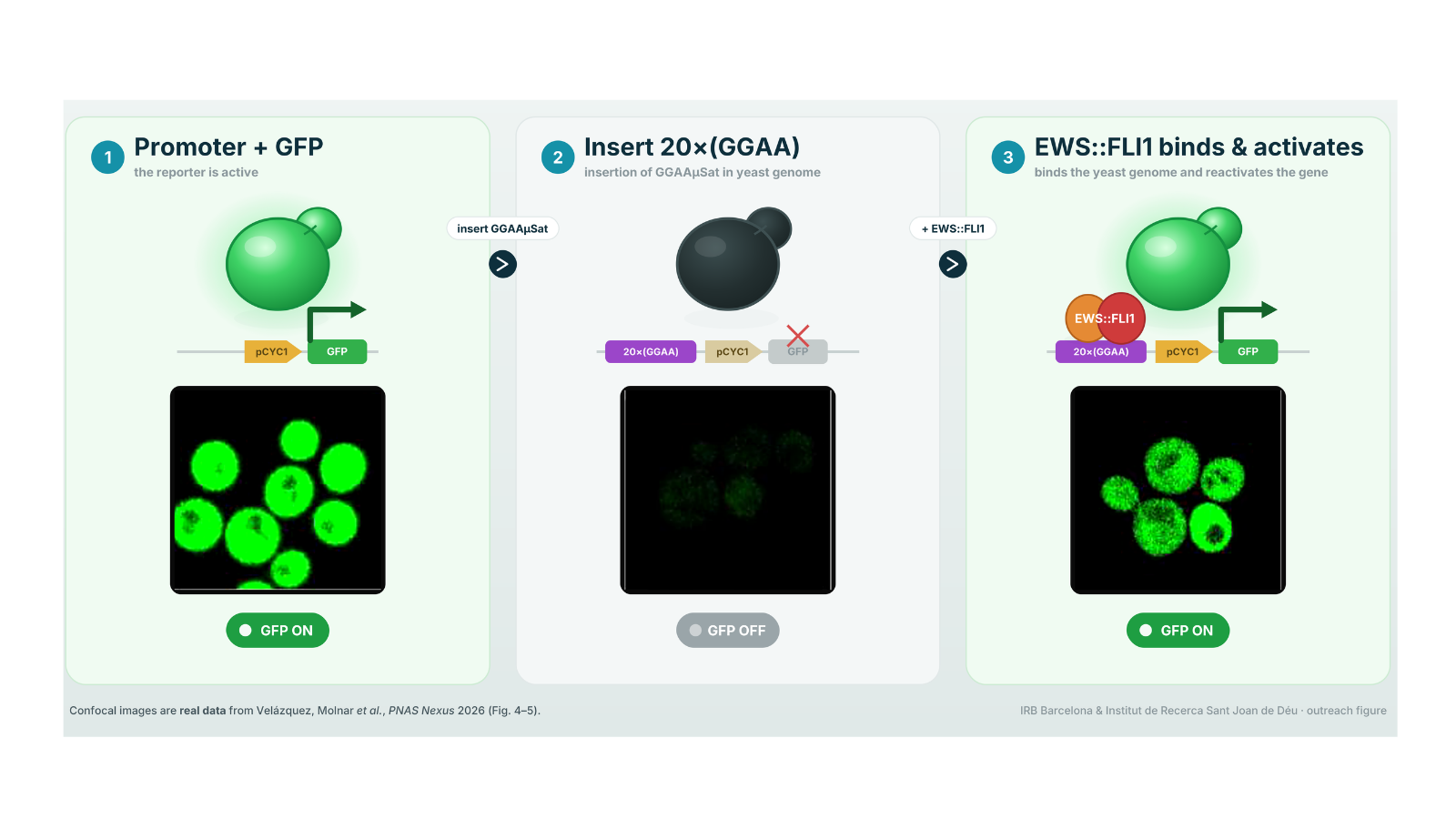
- Researchers from IRB Barcelona and Sant Joan de Déu have used yeast to study the mechanism used by EWS::FLI1, the main oncogenic protein that drives Ewing sarcoma.
- In yeast, the oncogenic protein maintains its capacity to activate normally silenced repetitive regions of DNA, but largely loses its ability to alter gene expression genome-wide.
- The study, published in PNAS Nexus, indicates that these two functions depend on distinct molecular mechanisms.
Ewing sarcoma is an aggressive type of cancer that mainly affects adolescents and young adults and, in most cases, is driven by an abnormal protein called EWS::FLI1.
A team from IRB Barcelona, in collaboration with the Institut de Recerca Sant Joan de Déu and the Pediatric Cancer Center Barcelona at Hospital Sant Joan de Déu, has used yeast (a much simpler cellular system than animal cells) to separately study two of the primary activities of this protein: its ability to activate specific DNA regions and to broadly alter gene expression.
The study, published in PNAS Nexus, shows that these two activities do not depend on the same cellular machinery. In yeast, EWS::FLI1 retains the ability to activate normally silenced repetitive DNA regions, but largely loses its ability to reprogram gene expression on a global scale.
“Working with increasingly simple organisms allows us to take the mechanism apart piece by piece. Yeast eliminates many of the factors present in animal cells and helps us distinguish between oncogene activities that require evolutionarily conserved components and those of more recent evolution,” explains Dr. Cayetano González, Emeritus Professor at IRB Barcelona, who co-led the work.
Simplifying the system to understand the mechanism
The work builds upon previous studies by the team in Drosophila. In the fly, EWS::FLI1 reproduces several of the molecular activities observed in Ewing sarcoma, including widespread dysregulation of expression affecting hundreds of genes.
Yeast offers an even simpler and evolutionarily more distant system. It lacks several proteins and molecular complexes involved in EWS::FLI1 activity in animal cells. This allowed the scientists to investigate which protein functions are retained even when much of its usual molecular environment is removed.
The researchers observed that EWS::FLI1 was able to bind to hundreds of sites in the yeast genome and redistribute RNA polymerase II—the machinery that enables DNA transcription—toward them. However, these changes barely translated into alterations in gene expression.
A capability preserved even in yeast
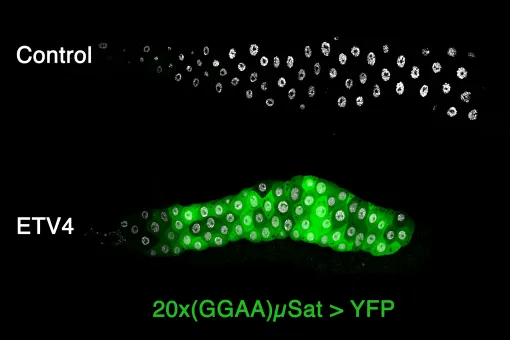
The clearest difference appeared when introducing GGAA microsatellites—repetitive sequences naturally absent in this organism—into the yeast genome. These repeats silenced the activity of an adjacent gene. When EWS::FLI1 was expressed, the protein was able to reverse this silencing and reactivate the gene.
“The most striking finding was that EWS::FLI1 is still capable of activating these sequences even in a cell so different from a human cell, and one that lacks several of the factors we previously considered essential for this process. The fact that a protein that causes cancer in humans still functions in yeast is fascinating: it turns this humble organism into an unexpected ally in decoding Ewing sarcoma,” explains Dr. Diego Velázquez, co-first author of the study along with Dr. Cristina Molnar.
The results indicate that the ability of EWS::FLI1 to activate GGAA microsatellites may rely on very basic cellular mechanisms or functionally equivalent pathways. In contrast, its capacity to extensively reprogram gene expression appears to depend to a greater extent on components specific to animal cells.
Yeast does not reproduce Ewing sarcoma, but it provides a simplified experimental system in which different functions of EWS::FLI1 can be studied separately. The model now opens up the possibility of performing genome-wide genetic screens to identify which cellular components are required for each activity. Dr. Diego Velázquez, co-first author of the study, will continue developing this line of work in yeast in Dr. Francesc Posas’ laboratory at IRB Barcelona, under the supervision of Dr. González.
“Understanding the mechanisms EWS::FLI1 requires to alter gene activity is essential to better understanding the biology of Ewing sarcoma. This model allows us to deconstruct a very complex process and study separately which elements are truly necessary for the oncogenic protein to act,” highlights Dr. Jaume Mora, who co-led the work.
The study received funding from the European Regional Development Fund, the Ministry of Science and Innovation, the State Research Agency, and the Fundació Sant Joan de Déu per la Recerca.
Related article:
Ancient and Animal-Specific Regulatory Modes of EWS::FLI1 Revealed by a Minimal Yeast Model
Diego Velázquez, Cristina Molnar, Jose Reina, Jaume Mora and Cayetano Gonzalez
PNAS Nexus (2026) DOI: 10.1093/pnasnexus/pgag329
About IRB Barcelona
The Institute for Research in Biomedicine (IRB Barcelona) pursues a society free of disease. To this end, it conducts multidisciplinary research of excellence to cure cancer and other diseases linked to ageing. It establishes technology transfer agreements with the pharmaceutical industry and major hospitals to bring research results closer to society, and organises a range of science outreach activities to engage the public in an open dialogue. IRB Barcelona is an international centre that hosts 400 researchers and more than 30 nationalities. Recognised as a Severo Ochoa Centre of Excellence since 2011, IRB Barcelona is a CERCA centre and member of the Barcelona Institute of Science and Technology (BIST).