Images
- Researchers at IRB Barcelona develop a computational framework that creates molecules with selective activity in specific cell types, without the need to start from a predefined molecular target.
- Published in Communications Chemistry, the new strategy combines predictive and generative AI to design new chemical entities with specific biological effects.
- Experimental validation confirmed that several of the AI-generated molecules displayed the activity they were designed for, achieving a success rate superior to that of traditional screening methods.
The classical drug discovery paradigm begins with a known molecular target: a protein whose modulation is expected to reverse the course of a disease. However, in many pathologies, such a target does not always exist or is not sufficiently characterized.
Now, the Structural Bioinformatics and Network Biology lab at IRB Barcelona, led by Dr. Patrick Aloy, proposes a new strategy to design molecules based not on a specific protein, but on the effect they wish to induce in cells.
In this approach, known as phenotypic discovery, the starting point is not a specific molecular target, but an observable response in the cell—for example, a molecule acting on a specific cell type and not on others.
To test the methodology, the team used various cell models, including pancreatic cancer-derived lines and control cells.
“For the first time, we have designed new chemical entities using artificial intelligence based on the biological effect we wanted to achieve, and we have experimentally demonstrated that they work on specific cells,” explains Dr. Patrick Aloy, ICREA researcher at IRB Barcelona.
Pushing the boundaries of screening
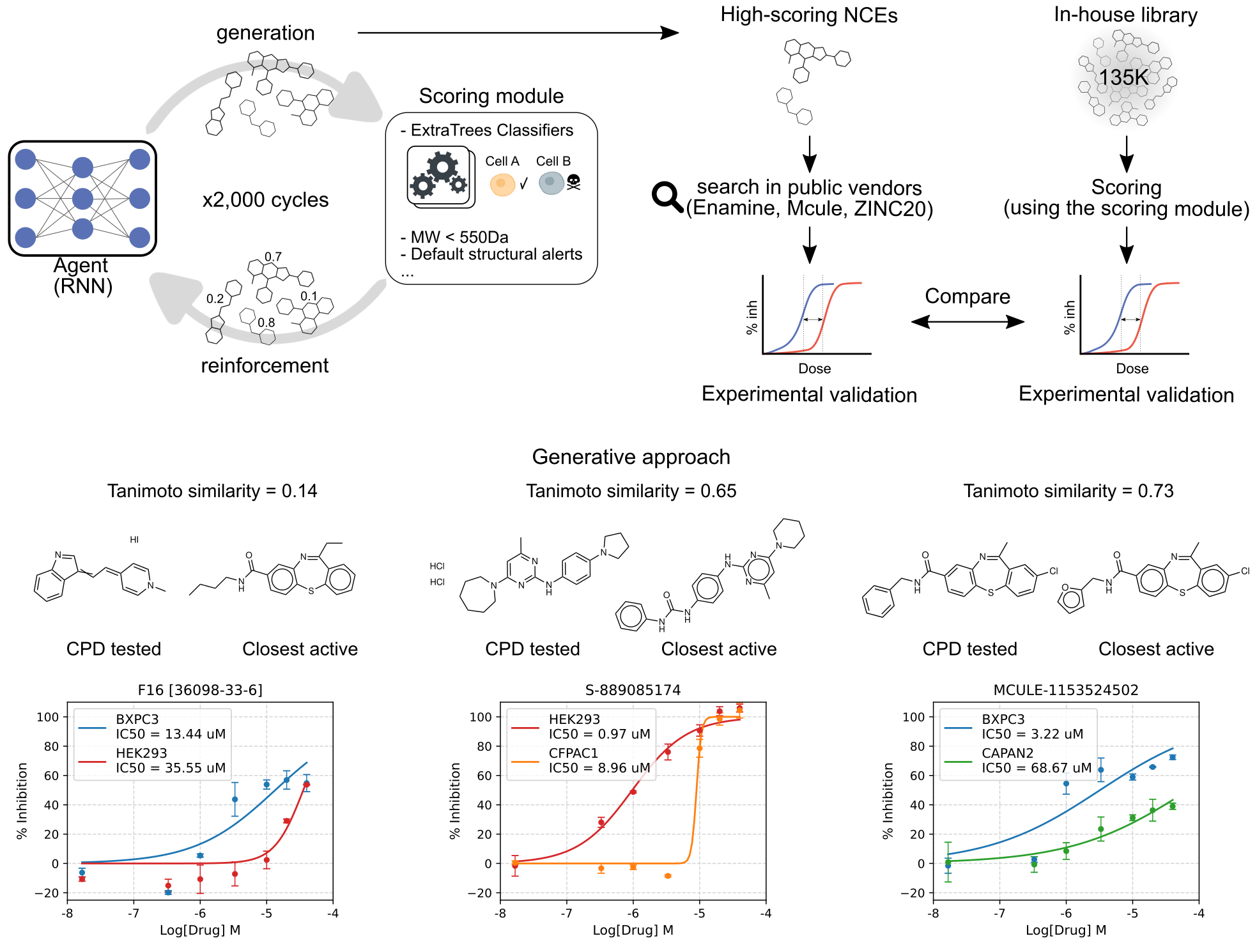
To train the system, the researchers first generated their own database by testing more than 11,000 chemical compounds across eight different cell models: six pancreatic cancer lines and two controls. Using these data, they created predictive models based on the bioactivity information of each molecule on the cells, which proved to be much more accurate than methods based solely on chemical similarity between compounds.
Subsequently, they integrated these models into a generative AI and machine learning system capable of proposing new candidate molecules. The goal was to design new molecules under a dual criterion: that they be active against a specific cell type while having a lesser effect on control cells or other cellular profiles.
Experimental validation: from computer to laboratory
The team experimentally evaluated many of the AI-designed molecules, and several matched the function they were designed for: acting selectively on certain cell models while having a lesser effect on others.
The AI-designed molecules not only demonstrated superior activity compared to those obtained through conventional screening strategies, but many of them also turned out to be structurally innovative and distinct from known chemical compounds.
Although this is still an early stage of compound discovery, this methodology opens up new possibilities for identifying candidate molecules in a faster and more targeted manner, especially in contexts where there is no clear therapeutic target.
Related article:
Phenotypic AI-based design of cell-specific small molecule cytotoxics
Gema Rojas-Granado, Marta Sánchez-Soto, Jesús Calahorra, María Caballero, Israel Ramos , Martino Bertoni & Patrick Aloy
Communications Chemistry (2026) DOI: 10.1038/s42004-026-02071-x
About IRB Barcelona
The Institute for Research in Biomedicine (IRB Barcelona) pursues a society free of disease. To this end, it conducts multidisciplinary research of excellence to cure cancer and other diseases linked to ageing. It establishes technology transfer agreements with the pharmaceutical industry and major hospitals to bring research results closer to society, and organises a range of science outreach activities to engage the public in an open dialogue. IRB Barcelona is an international centre that hosts 400 researchers and more than 30 nationalities. Recognised as a Severo Ochoa Centre of Excellence since 2011, IRB Barcelona is a CERCA centre and member of the Barcelona Institute of Science and Technology (BIST).