Images
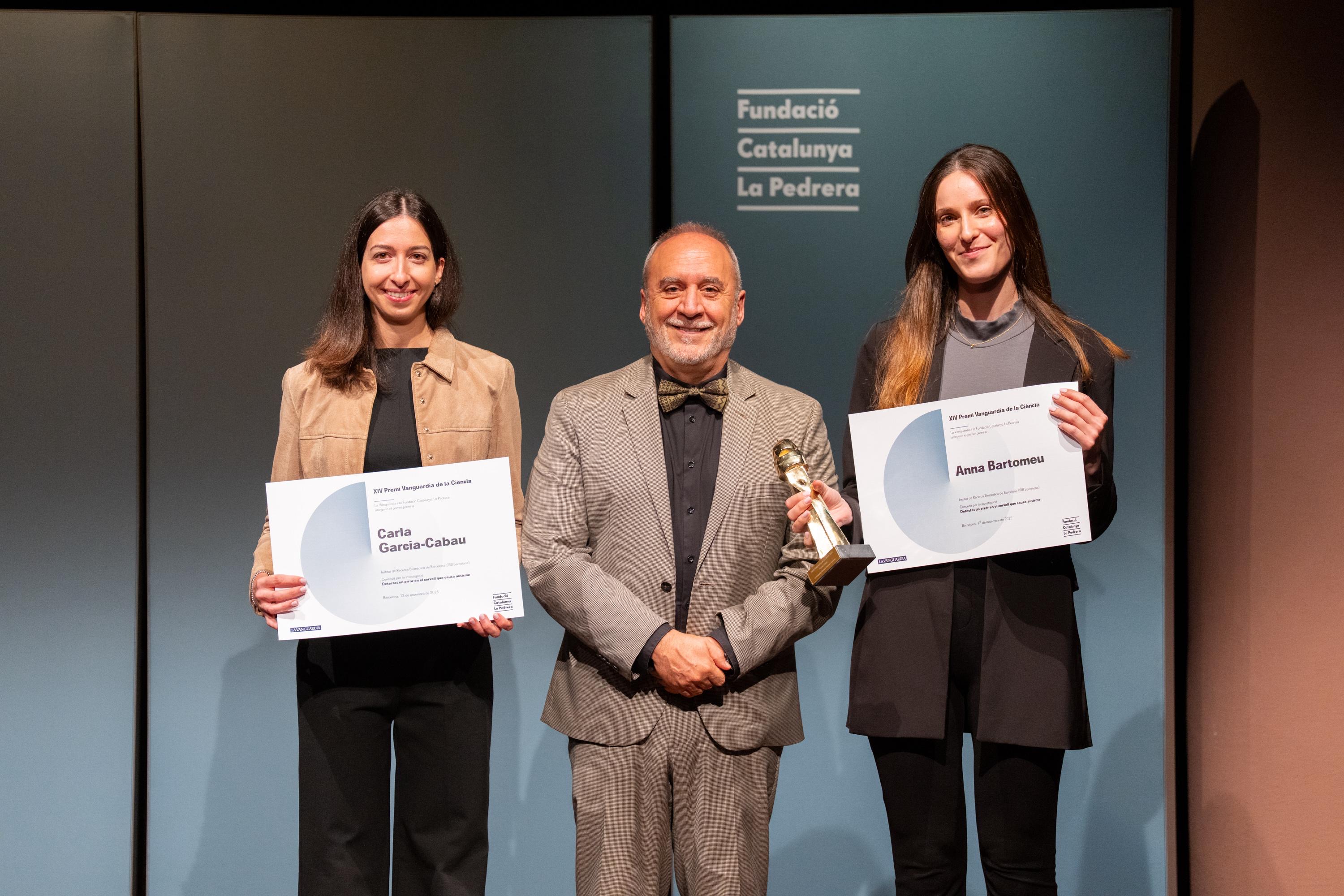

• Dr. Carla Garcia Cabau and Dr. Anna Bartomeu receive two important awards for their study on autism: the Pfizer Foundation Award and the prestigious Vanguàrdia Science Award.
• This double recognition highlights the scientific excellence of the study and reinforces the Institute's commitment to fundamental research with a high social impact.
In late 2024, a team from IRB Barcelona published a study in Nature demonstrating how the absence of a microexon in the CPEB4 protein favours the formation of aggregates in neuronal condensates and, consequently, alters the expression of key genes for the development of the nervous system. The study was conducted jointly by the Translational Control of Cell Cycle and Differentiation Laboratory, led by Dr. Raúl Méndez, and the Molecular Biophysics Laboratory, headed by Dr. Xavier Salvatella. This work offers a fresh perspective on idiopathic autism—accounting for nearly 80% of cases—and opens the door to the development of new, targeted therapies.
Now, the relevance of this finding has been endorsed by two prestigious awards: the Pfizer Foundation Award and the Vanguardia Science Award, which place this research among the year's most notable advancements.
On 6 November, the Pfizer Foundation announced the the XXVI edition of the Scientific Innovation Awards for Young Researchers, in the categories of Basic and Clinical Research in biomedicine and health sciences. In this call, the IRB Barcelona autism project was recognized for its outstanding quality and potential to impact health, and the award was given to one of the study’s lead authors, Dr. Carla Garcia Cabau.
On 12 November, the researchers Dr. Garcia Cabau and Dr. Bartomeu were presented with the 2025 Vanguardia Science Award for their contribution to the understanding of autism through the study published in Nature. Granted by La Vanguardia and the Catalunya La Pedrera Foundation, this prize distinguishes the most relevant scientific advances of the year led by women and underscores the need to promote their visibility and presence in high-impact scientific areas. Watch the video of the event here.
“Receiving these awards is a recognition of the effort of all the years dedicated to this research, and it is also an impetus to continue investigating with enthusiasm. Furthermore, it is an important acknowledgement of basic science and the collaborative work between disciplines, which has been essential to achieve this advance,” says Dr. Garcia Cabau.
“For us, this recognition is a true honour, especially considering the extraordinary level of women doing science in Spain. It is also a reminder that research has a real impact, and it is very exciting to see how society recognizes and supports this work,” adds Dr. Bartomeu.
For IRB Barcelona, this double recognition reaffirms its commitment to research of excellence aimed at bringing about a real impact on people's lives.
The research team will continue the line of work focused on the function of the CPEB4 protein and its neuronal microexon to advance knowledge of idiopathic autism and explore how this mechanism can be leveraged to design new therapeutic strategies.
About IRB Barcelona
The Institute for Research in Biomedicine (IRB Barcelona) pursues a society free of disease. To this end, it conducts multidisciplinary research of excellence to cure cancer and other diseases linked to ageing. It establishes technology transfer agreements with the pharmaceutical industry and major hospitals to bring research results closer to society, and organises a range of science outreach activities to engage the public in an open dialogue. IRB Barcelona is an international centre that hosts 400 researchers and more than 30 nationalities. Recognised as a Severo Ochoa Centre of Excellence since 2011, IRB Barcelona is a CERCA centre and member of the Barcelona Institute of Science and Technology (BIST).