Images
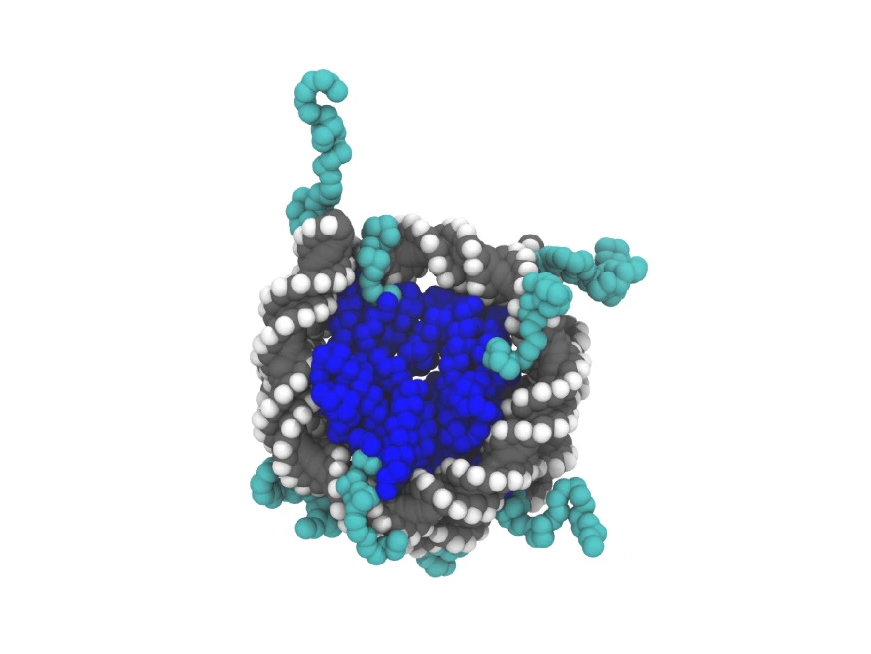
- OpenCGChromatin allows researchers to simulate how chromatin is organised and moves in fine molecular detail.
- Published in Nature Communications, the study is a collaboration between IRB Barcelona, the University of Cambridge, UT Southwestern Medical Centre and the Howard Hughes Medical Institute.
The DNA in our cells wraps around proteins called histones to form nucleosomes, which organize into chromatin. This organisation helps pack genetic material into the nucleus and influences how easily genes can be read and DNA damage repaired. Understanding how chromatin changes requires studying molecular movements and interactions that are difficult to capture experimentally.
An international research team led by IRB Barcelona, the University of Cambridge, UT Southwestern Medical Center and the Howard Hughes Medical Institute has developed OpenCGChromatin, a tool that works as a “computational microscope”: through simulations, it allows researchers to explore how chromatin folds, how its components interact and which forces hold its structures together.
“The challenge is to connect interactions between individual molecules with the behaviour of much larger stretches of chromatin. This tool allows us to study both within the same framework and understand how small molecular changes can alter DNA packaging,” says Dr. Modesto Orozco, head of the Molecular Modeling and Bioinformatics Laboratory at IRB Barcelona, ICREA Academia researcher, and professor at the University of Barcelona, who co-led the study.
“OpenCGChromatin was inspired by beautiful cryo-ET experimental work from Professor Michael Rosen’s group at UT Southwestern Medical Center and the Howard Hughes Medical Institute, who co-led this study with us. ,” says Professor Rosana Collepardo-Guevara of the University of Cambridge, who co-led the study.
From molecular interactions to DNA packaging
The tool combines a detailed representation of DNA and proteins with greater computational efficiency. This allows researchers to study chromatin systems more than ten times larger than those accessible to previous models with comparable resolution, including assemblies containing hundreds of nucleosomes, the basic units of DNA packaging.
The simulations reproduce observations from microscopy and biochemical experiments while revealing movements of flexible histone regions that are difficult to resolve experimentally.
“What Kieran Russell, first author of this study, has achieved is remarkable. He has pushed the state of the art in chromatin modelling, allowing us to simulate systems at a scale and level of molecular detail that were previously out of reach. We can now connect the chemical makeup of chromatin to its organisation across scales—from molecular interactions to gene-sized structures and biomolecular condensates—while remaining closely grounded in experiment. I am very excited because OpenCGChromatin opens up a completely new range of questions that we can now address computationally,” says Collepardo-Guevara.
“The simulations help us understand why changing the spacing between nucleosomes, or adding chemical modifications to histones, can make chromatin behave differently”, explained David Farré-Gil, also an author of the paper.
OpenCGChromatin is available as open-source software, allowing other researchers to use it to investigate the physical principles underlying genome organisation.
Related article:
Near-atomistic simulations reveal the molecular principles that control chromatin structure and phase separation
Kieran Russell, Yifang Chen, Jorge R. Espinosa, David Farré-Gil, Huabin Zhou, Maria Julia Maristany, Jose Ignacio Perez-Lopez, Jan Huertas, Modesto Orozco*, Michael K. Rosen* & Rosana Collepardo-Guevara*
Nature Communications (2025) DOI: 10.1038/s41467-026-78050-6
About IRB Barcelona
The Institute for Research in Biomedicine (IRB Barcelona) pursues a society free of disease. To this end, it conducts multidisciplinary research of excellence to cure cancer and other diseases linked to ageing. It establishes technology transfer agreements with the pharmaceutical industry and major hospitals to bring research results closer to society, and organises a range of science outreach activities to engage the public in an open dialogue. IRB Barcelona is an international centre that hosts 400 researchers and more than 30 nationalities. Recognised as a Severo Ochoa Centre of Excellence since 2011, IRB Barcelona is a CERCA centre and member of the Barcelona Institute of Science and Technology (BIST).