Images
- A team from IRB Barcelona, in collaboration with the Sant Joan de Déu Research Institute and the Pediatric Cancer Center Barcelona at Sant Joan de Déu Hospital, has described a mechanism by which a cancer-related protein can activate regions of DNA that normally remain silenced.
- Using the Drosophila fruit fly, the researchers demonstrated that this activation depends on collaboration with another protein, enabling the study of a mechanism that is difficult to isolate in human cells.
- The study, published in G3: Genes|Genomes|Genetics, may help explain previous observations in prostate cancer and B-cell acute lymphoblastic leukemia.
In Ewing sarcoma, an abnormal protein formed by the fusion of two genes can activate repetitive DNA regions that normally remain silenced and turn them into gene regulatory elements. This mechanism contributes significantly to the development of this tumour and is one of its best-studied molecular hallmarks.
A team led by Dr. Cayetano González, research professor (emeritus) at IRB Barcelona and ICREA, in collaboration with Dr. Jaume Mora, from the Pediatric Cancer Center Barcelona at Hospital Sant Joan de Déu, has described how this type of activation can occur without the involved proteins being fused. The study, conducted in the fruit fly Drosophila melanogaster, identifies collaboration between two proteins as a key requirement to activate these DNA regions.
Previous studies had observed that proteins from the ETS family can also activate these sequences—known as GGAA microsatellites—in prostate cancer and B-cell acute lymphoblastic leukemia. However, the mechanism by which they achieved this without being part of a fusion protein remained unclear.
A necessary collaboration
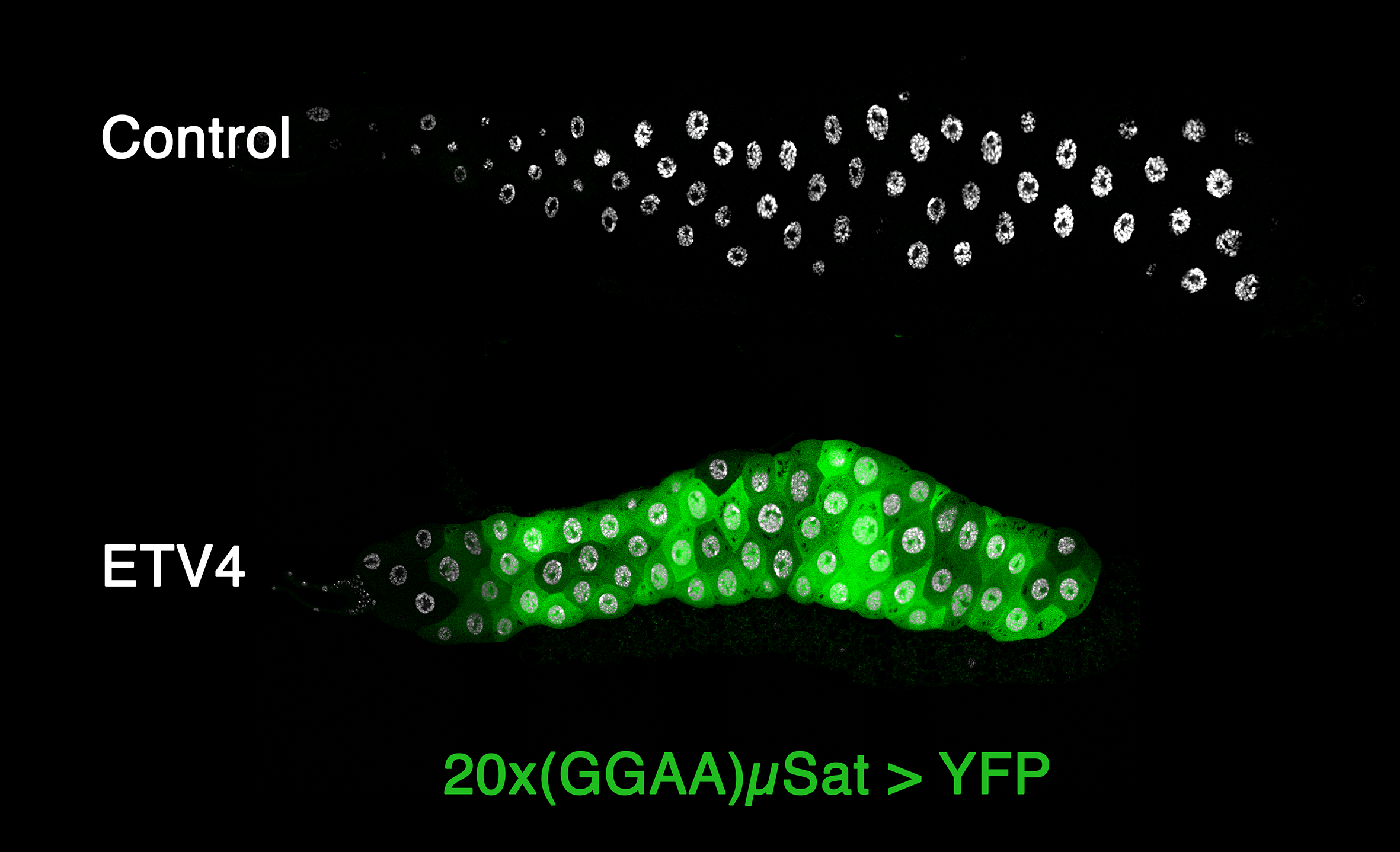
To study this process, the team introduced different human cancer-related ETS proteins into Drosophila. One of them, ETV4, previously implicated in prostate cancer, robustly activated GGAA microsatellites in specific fly tissues.
“The fact that this mechanism also works in the fly indicates that it has been conserved across a vast evolutionary distance and reinforces the potential relevance of the abnormal activation of these DNA regions in tumours beyond Ewing sarcoma,” explains Dr. Cayetano González.
The choice of Drosophila made it possible to solve an experimental hurdle. In humans, there are three very similar proteins from the FET family—FUS, EWSR1, and TAF15—that can compensate for one another. The fly, in contrast, has a single equivalent protein, called Cabeza (Caz). When Caz levels were reduced, the activation triggered by ETV4 dropped dramatically; when the human EWSR1 protein was introduced, activity was restored.
“The fact that a protein capable of activating these silent DNA regions in human tumour cells can also do so in fly cells reinforces the value of Drosophila as a model to investigate how these regions are activated and what other proteins participate in this process,” explains Dr. Cristina Molnar, postdoctoral researcher at IRB Barcelona and first author of the study.
Beyond Ewing sarcoma
The results help explain a key difference with respect to Ewing sarcoma. In this tumour, the FET and ETS components are joined in a single fusion protein, whereas ETV4 must collaborate with an independent FET protein to activate the same DNA regions. The Ewing sarcoma fusion protein, on the other hand, can do so without depending on Caz.
The team also verified that ETV6, a protein that halts this process in human cells, also blocks ETV4 activity in the fly, reinforcing the idea that key components of the mechanism are conserved across species.
“Understanding how these DNA regions can be activated outside the classic context of Ewing sarcoma can help us better understand mechanisms that are also altered in other types of cancer,” notes Dr. Jaume Mora.
This work was supported by funding from the European Regional Development Fund (ERDF), the Ministry of Science and Innovation, the State Research Agency, and the Fundació Sant Joan de Déu per la Recerca.
Related article:
The Drosophila FET ortholog Cabeza is an essential cofactor for ETV4-mediated activation of GGAA microsatellite neoenhancers
Cristina Molnar, Jose Reina, Jaume Mora, Cayetano Gonzalez
G3: Genes|Genomes|Genetics (2026) DOI: 10.1093/g3journal/jkag265
About IRB Barcelona
The Institute for Research in Biomedicine (IRB Barcelona) pursues a society free of disease. To this end, it conducts multidisciplinary research of excellence to cure cancer and other diseases linked to ageing. It establishes technology transfer agreements with the pharmaceutical industry and major hospitals to bring research results closer to society, and organises a range of science outreach activities to engage the public in an open dialogue. IRB Barcelona is an international centre that hosts 400 researchers and more than 30 nationalities. Recognised as a Severo Ochoa Centre of Excellence since 2011, IRB Barcelona is a CERCA centre and member of the Barcelona Institute of Science and Technology (BIST).