Images
- Aneuploidy—the presence of an incorrect number of chromosomes—is common during the normal development of human embryos and is the main cause of spontaneous miscarriage.
- A team of researchers at IRB Barcelona has developed a genetic tool to create customized aneuploidies and analyse their impact during development.
- Published in Cell Genomics, the study demonstrates that aneuploid cells are actively eliminated by neighbouring cells through cell competition.
- These mechanisms may be involved in the removal of aneuploid cells during early human development.
More than 80% of early human embryos contain cells with an incorrect number of chromosomes—a phenomenon called aneuploidy. This typically stems from errors in chromosome segregation during the very first cell divisions. Remarkably, aneuploid cells are eliminated before implantation. When this does not happen, aneuploidy causes miscarriages or developmental disorders. Understanding how aneuploid cells are eliminated in these early stages is crucial for gaining insights into fertility, and it could also have implications for diseases like cancer.
A team led by Dr. Marco Milán at IRB Barcelona has developed a tool that can generate customized aneuploidies and that precisely labels the cells that carry these aneupoidies in living tissue, offering an unprecedented window through which to observe the behaviour of these cells in real-time.
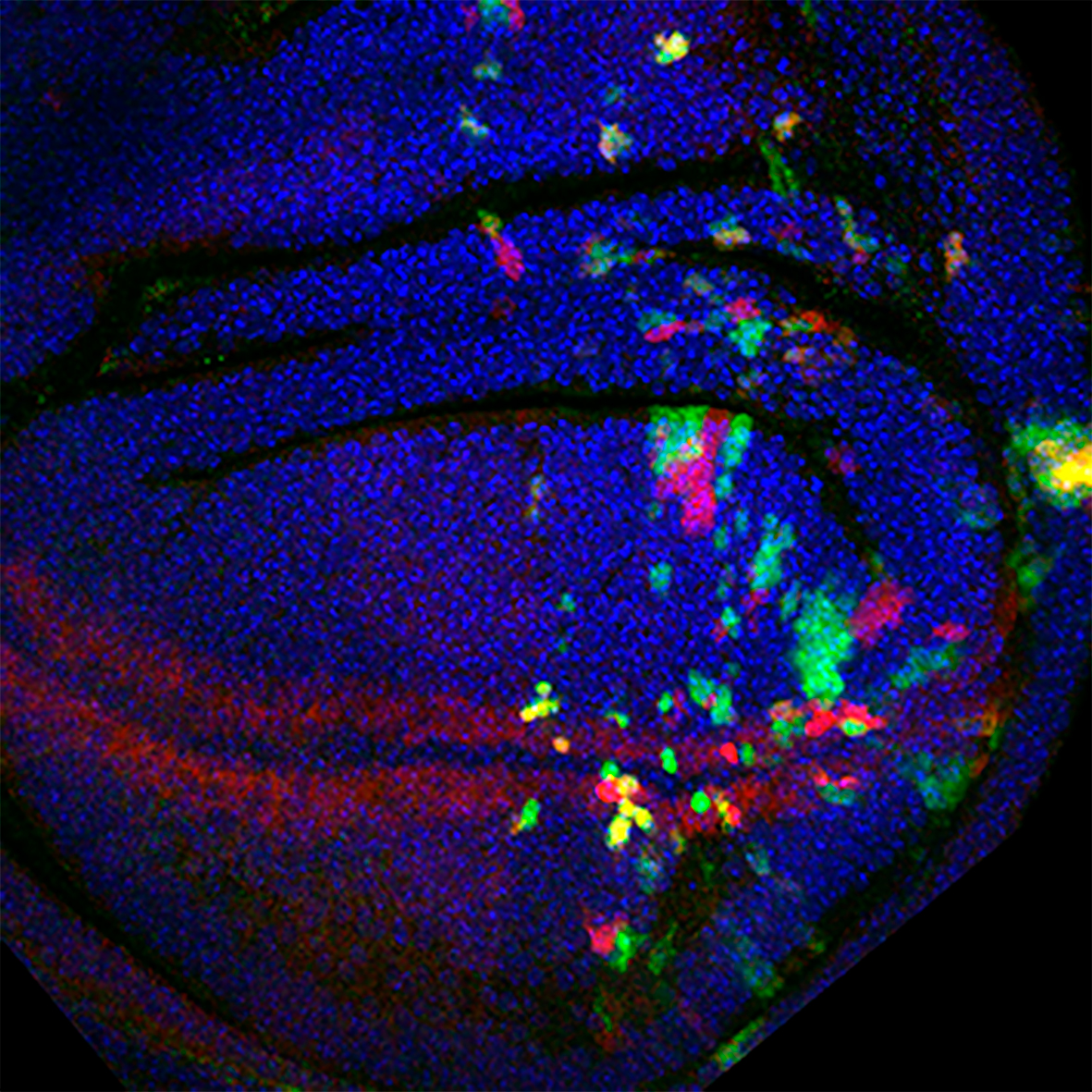
Published in the journal Cell Genomics, the method acts like a pair of “molecular scissors”, allowing the number of copies of large regions of the genome to be changed, leading to both monosomies (a single copy) and trisomies (three copies). “We can select which bit of the genome we want to alter and can immediately observe how cells respond,” explains Dr. Milán, ICREA researchers at IRB Barcelona. The tool was tested in epithelial tissue from the Drosophila fly.
The main conclusions drawn by the study are, on the one hand, the presence of a high number of haploinsufficient genes (genes in which a single copy weakens the growth and survival of monosomic cells), and, on the other, that their removal is expedited by cell competition with fitter neighbouring cells. The elimination of aneuploid cells, therefore, depends on both the internal gene deficit and the environment.
When “a copy of the instruction manual is missing”
Monosomic cells lose one of the two chromosomal doses, impacting dozens or hundreds of key genes. Some of these genes are haploinsufficient, meaning a single copy no longer produces enough protein to keep the cellular machinery operating at full capacity.
Among the most well-known haploinsufficient genes are those that code for ribosomal proteins, the fundamental building blocks of the cell's protein-making machinery. When a cell suddenly reduces the amount of even a single ribosomal subunit, overall protein production slows down, leading to increased cellular stress. This deficit turns the cell into a "weak player" within the tissue.
Thanks to one of the two systems developed in this work, which allows researchers to generate monosomic cells within normal tissue, it's been demonstrated that the genome contains a large number of haploinsufficient genes beyond those coding for ribosomal proteins. This research also shows that monosomic cells are eliminated through various molecular mechanisms of cell competition.
Cell competition
The experiments show that monosomic cells grow more slowly but that their final destination is determined by surrounding cells. Thanks to the second system developed in this study, which allows the generation of monosomic and trisomic cells simultaneously in the same tissue, the researchers observed that the latter can accelerate the removal of monosomic cells. “We found that the “fittest” cells literally push aneuplodies towards apoptosis; if these aneuploidy cells are left alone, they can survive,” says Dr. Elena Fusari, first author of the study and recipient of a “la Caixa” fellowship.
The results indicate that the interaction between the cells themselves is as important as the aneuploidy, an idea that paves the way for treatments that modify neighbouring cells to force the removal of pathological clones.
Consequences for fertility and oncology
Recreating this cellular duel helps explain why in vitro fertilization (IVF) clinics typically discard embryos with high levels of aneuploidy. “In the field of assisted reproduction, there's a growing reconsideration of current embryo selection criteria. This shift comes as new research suggests that embryos may actually be capable of eliminating problematic cells on their own,” says Dr. Fusari. Also, understanding the “rules” of competition between aneuploid cells paves the way towards the development of therapies to clear cancer cells, which are also aneuploid, from healthy tissue.
Next steps
Using the developed tool, the team plans to carry out an exhaustive search of all haploinsufficient regions of the Drosophila genome. “The goal is to map which genes trigger competition signals and how we can modulate this response,” concludes Dr. Milán. In the long-term, this knowledge could be used to increase the success rate of assisted reproduction treatments and to develop drugs to tackle aneuploidy, which is a characteristic of many tumours.
The study was supported by the Fundación “la Caixa”, the Ministry of Science and Innovation, the ERDF, and the Government of Catalonia, through the CERCA program.
Related article:
Depletion of aneuploid cells is shaped by cell-to-cell interactions
Elena Fusari, Mariana Muzzopappa, Juliette Gracia and Marco Milán
Cell Genomics (2025) DOI:
About IRB Barcelona
The Institute for Research in Biomedicine (IRB Barcelona) pursues a society free of disease. To this end, it conducts multidisciplinary research of excellence to cure cancer and other diseases linked to ageing. It establishes technology transfer agreements with the pharmaceutical industry and major hospitals to bring research results closer to society, and organises a range of science outreach activities to engage the public in an open dialogue. IRB Barcelona is an international centre that hosts 400 researchers and more than 30 nationalities. Recognised as a Severo Ochoa Centre of Excellence since 2011, IRB Barcelona is a CERCA centre and member of the Barcelona Institute of Science and Technology (BIST).